 Rob
Rob
This fall word search uses one original vocabulary pack for autumn, with two different grids and matching answers. You can choose a forward-direction search or an all-directions version, then print either in standard or larger lettering. The page combines “fall” and “autumn” wording so you do not need to navigate separate copies of the same resource.
Open the forward autumn puzzle, forward large-print puzzle, all-directions puzzle or all-directions large-print puzzle. Each file has a puzzle page followed by its answer page.
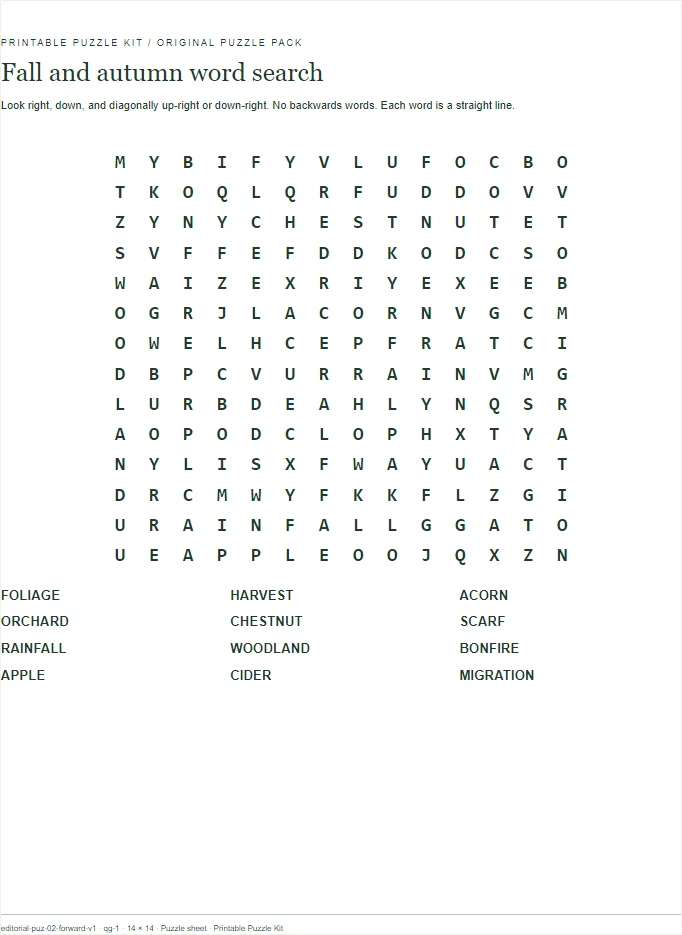
A seasonal word list with several ways in
The exact printed word bank
- FOLIAGE
- HARVEST
- ACORN
- ORCHARD
- CHESTNUT
- SCARF
- RAINFALL
- WOODLAND
- BONFIRE
- APPLE
- CIDER
- MIGRATION
| Search arrangement | Standard lettering | Larger lettering |
|---|---|---|
| Four forward directions | Standard forward sheet | Large forward sheet |
| All eight directions | Standard all-directions sheet | Large all-directions sheet |
The twelve words are foliage, harvest, acorn, orchard, chestnut, scarf, rainfall, woodland, bonfire, apple, cider and migration. They mix objects, places and seasonal associations rather than repeating a list of holiday names. The theme is a vocabulary choice, not a claim that every place experiences the same weather or seasonal events.
Some entries are short and familiar, while others create longer paths through the grid. That variation lets you change your scanning approach when one word is elusive. You do not need to know a specialist definition to solve the sheet because the complete word bank is printed underneath.
The two grids use the same bank in different arrangements. Standard and large-print layouts share their corresponding grid, so changing letter size does not change the answers. If you want a second search with the same vocabulary, change the direction setting rather than simply printing the larger version.
| Printed entry | Letters | Feature to check |
|---|---|---|
| MIGRATION | 9 | MIG at the beginning; confirm the complete endpoint |
| CHESTNUT | 8 | CHE at the beginning; confirm the complete endpoint |
| RAINFALL | 8 | Consecutive LL; check both cells |
Know exactly where words are allowed to run
In the forward puzzle, a word can run right, down, diagonally down-right or diagonally up-right. A diagonal rising towards the right is therefore permitted. Check all four possibilities from a promising starting letter before moving to the next one.
The all-directions puzzle adds the opposite directions. Words can run left, up or along either leftward diagonal. A sequence that looks reversed when read from the top or left may be a valid answer when followed from its first letter in the correct direction.
Words always form a straight line. They do not bend around a corner or jump over a cell. They may cross another word at a shared letter, and a letter already marked can still belong to a second answer. Keep that possibility in mind before dismissing a promising path.
Try a scan based on distinctive letter patterns
For CHESTNUT, the opening CH gives you a pair to search for rather than a single common letter. Find a C, check whether an H sits next to it in an allowed direction, then follow the rest of the word. This can reduce the number of full paths you inspect.
For APPLE, the repeated P is another useful feature. A potential A followed by only one P is not enough. Trace all five letters before crossing the word off the list. Repeated letters are easy to misread if you mark a word after recognising only its general shape.
If that approach stalls, switch to a systematic row scan for the first letter of one remaining word. Work across one row, then move down. A deliberate change of method can be more useful than repeatedly looking at the same area of the page.
Optional help with the longest entry
Show a hint for MIGRATION
In the forward grid, MIGRATION starts at row 6, column 14 and runs down to row 14, column 14. In the all-directions grid, it starts at row 12, column 9 and runs diagonally up-left to row 4, column 1. Count rows from the top and columns from the left, beginning at one.
You can read only the starting coordinate if you want a smaller hint. The answer page gives the full set of coordinates, but there is no need to consult every solution when you only want help with one word. Cover the remaining lines if keeping them hidden makes the search more enjoyable.
Print for the way you intend to solve
Before handing out copies
- Choose one arrangement and keep its matching answer sheet separately.
- Match A4 or Letter in the preview to the paper actually loaded.
- Print one proof, check the bank and grid edges, then make the remaining copies.
The standard grid uses fourteen-point letters before scaling, while the larger layout uses eighteen-point letters. Both are designed for portrait A4 or US Letter. Select the paper actually loaded into your printer and check that the grid, word bank and footer remain inside the page preview.
Printer scaling can alter the physical letter size. If you choose fit-to-page, inspect the result rather than assuming the original point size is preserved. The larger layout is a presentation option, not a guarantee that every person will find the same size comfortable.
Print the answer page separately when you want a clean solving sheet. For a group, make enough copies of page one and keep one matching page two nearby. Check the direction label and seed before using the solution, since the two grids place the same vocabulary differently.
Make it a shared autumn-table activity
A pair can solve one grid together, taking turns choosing a word from the bank. One person can trace a likely path while the other checks each letter. This makes the activity cooperative without needing an extra scoring system or any preparation beyond printing the sheets.
For individual copies, agree whether people want to compare progress or solve quietly. Some may prefer the forward setting while others choose all directions. If the group uses mixed settings, keep the answer pages labelled so a coordinate from one puzzle is not mistaken for an error in another.
You can leave the word search available during a gathering without making completion compulsory. It works as a short activity people can begin and return to. There are no missing trivia answers or required background readings before someone can join in.
How the answers are checked
Each listed word has one verified occurrence in its grid. The prepared answers identify the exact start and end cells, and the solution shading marks the cells on those paths. Where two words cross, the coordinate list tells you which line belongs to each entry.
A separate check scans the finished letters in every direction, rather than only trusting the original placement list. This catches an accidental extra occurrence created by filler letters. The seed printed on each sheet identifies the prepared version used for those checks.
Questions about the fall word search
Is there a separate autumn version?
No. Fall and autumn are two names for the same season, and this page provides one pack for both. These sheets use the same twelve-word seasonal vocabulary. Choose between the actual grid settings and print sizes on this page.
Can I reuse the sheets next year?
Yes. The puzzles contain no year-specific dates or references. Keep the seed and matching answer page with the printable so you can identify the correct solution whenever you use it.
Do I need coloured printing?
No. The puzzle is monochrome, and the answers combine shaded cells with written coordinates. The coordinate list remains useful even if your printer renders the shading faintly.