 Rob
This Christmas word search contains two original fourteen-by-fourteen puzzles built around twelve holiday words. Choose a forward-direction search or a separate all-directions grid, then print either with standard or larger lettering. Each prepared puzzle includes its matching solution, making it straightforward to put a few copies on a festive table.
Open the forward Christmas puzzle, forward large-print sheet, all-directions Christmas puzzle or all-directions large-print sheet. The puzzle comes first and the answer sheet follows on a separate page. Use browser print preview to choose the pages you want.
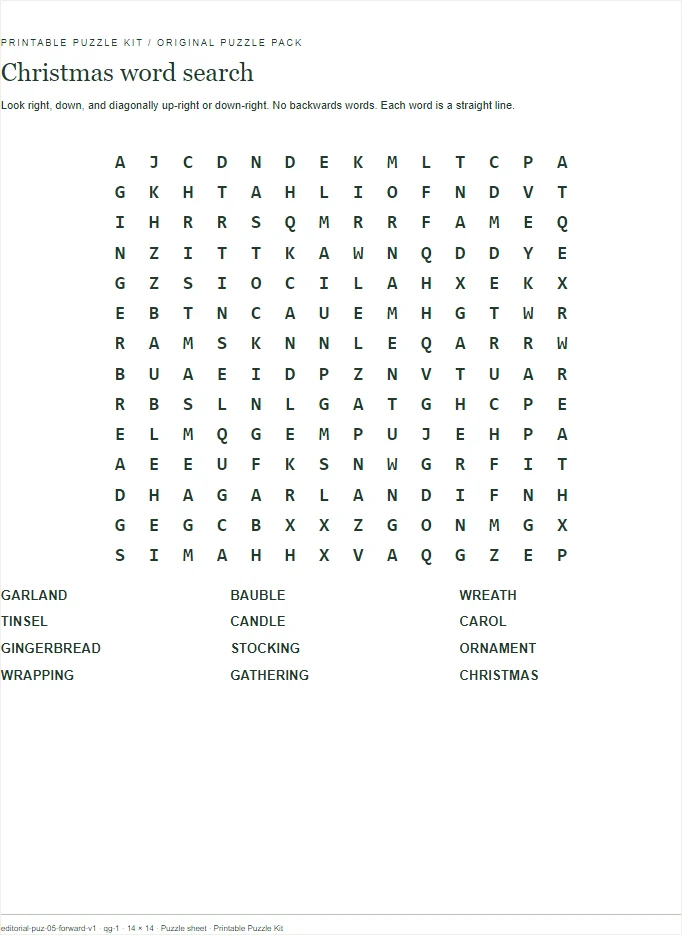
A holiday word list without a trivia requirement
The exact printed word bank
- GARLAND
- BAUBLE
- WREATH
- TINSEL
- CANDLE
- CAROL
- GINGERBREAD
- STOCKING
- ORNAMENT
- WRAPPING
- GATHERING
- CHRISTMAS
| Search arrangement | Standard lettering | Larger lettering |
|---|---|---|
| Four forward directions | Standard forward sheet | Large forward sheet |
| All eight directions | Standard all-directions sheet | Large all-directions sheet |
The pack brings together decorations, a food word and shared celebration vocabulary. Garland, bauble, wreath, tinsel, candle and ornament describe objects; gingerbread and stocking add familiar Christmas associations; carol, wrapping, gathering and Christmas complete the bank. Finding them requires matching letters, not remembering a song lyric or identifying a film character.
The list is deliberately compact. Twelve entries leave a clear word bank below the grid and give each found word a visible place to mark off. Both puzzles use this same list, so changing direction settings changes the search without asking the group to learn a new bank.
These are selected seasonal associations rather than a definition of how Christmas must be celebrated. A person can enjoy the letter search without sharing every custom suggested by the words. There are no questions about belief, family arrangements or personal plans to answer before beginning.
| Printed entry | Letters | Feature to check |
|---|---|---|
| GINGERBREAD | 11 | GIN at the beginning; confirm the complete endpoint |
| GATHERING | 9 | GAT at the beginning; confirm the complete endpoint |
| CHRISTMAS | 9 | CHR at the beginning; confirm the complete endpoint |
Notice the spelling features before searching
WRAPPING has two consecutive Ps. That pair is a useful anchor in a grid: if you see two adjacent Ps in an allowed direction, check whether the surrounding letters complete the word. A single P inside a plausible-looking fragment is not enough. Trace from W through the final G before marking the entry.
GINGERBREAD offers several distinct chunks: GINGER followed immediately by BREAD. In the grid it is one continuous eleven-letter sequence. Searching for BREAD can help locate a candidate, but the six letters before that part must also spell GINGER along the same straight line.
BAUBLE is a shorter word with an easily transposed middle. Use the printed order B-A-U-B-L-E rather than relying on a quick impression of the letters. WREATH begins with W-R, while the W is not pronounced separately in ordinary speech. A word search follows spelling, so the initial W must still be present.
Choose a direction rule that suits the occasion
The forward sheet allows four directions: right, down, down-right and up-right. An upward diagonal is therefore valid even though an upward vertical word is not part of that setting. Read the rule from the word’s first letter to its last, not from whichever end you happened to notice first.
The all-directions sheet allows those four paths and their opposites. A word can run left across a row, upwards in a column or along either leftward diagonal. This broadens the search positions; it is an objective rule difference rather than an age grade or a promise that everyone will find the same sheet harder.
For a casual table activity, give everyone the same direction setting if they will exchange hints. Participants may still choose different print sizes, because standard and large-print sheets within one setting use identical letters and answers. The two settings themselves use different arrangements.
Use a long word to establish your first path
A longer entry such as GINGERBREAD can be a useful first target because a complete eleven-letter match is distinctive. Scan for its first G, then inspect the next letter in each permitted direction. Reject a direction as soon as its sequence stops matching rather than tracing a winding route through nearby letters.
Words remain straight from start to finish. You cannot follow GINGER down a column and turn right to finish BREAD. A tempting bend usually means part of the sequence matched by chance. Return to the starting letter and try another allowed line.
Show a specific GINGERBREAD hint
In the forward puzzle, GINGERBREAD starts at row 2, column 1 and runs down to row 12, column 1. In the all-directions puzzle, it starts at row 5, column 1 and runs right to row 5, column 11. Rows count from the top and columns from the left.
The hint belongs to the prepared sheets linked above. If you make a fresh grid elsewhere, the same word may be placed differently. Keep the direction label with the sheet when sharing a coordinate hint so it points to the intended arrangement.
Mark overlapping words without losing letters
Two answers may share a letter. That shared cell still belongs to both words, so do not rule out a candidate because part of it has already been circled. A thin pencil line around the complete word leaves the printed letters easier to inspect than a heavy scribble through them.
Cross off the bank entry only after checking the whole sequence. If several people share one sheet, agree whether a tick, underline or single stroke means “found”. Mixing provisional and final marks can make it difficult to tell which of the twelve words remain.
If a circle obscures a crossing, use the unmarked printable on screen or a spare sheet to confirm the letters. The answer page also provides start and end coordinates. Its shaded cells show all solutions together, so the coordinate list is especially useful where several highlighted paths meet.
Prepare copies without exposing the solution
Before handing out copies
- Choose one arrangement and keep its matching answer sheet separately.
- Match A4 or Letter in the preview to the paper actually loaded.
- Print one proof, check the bank and grid edges, then make the remaining copies.
The standard layout sets grid letters at fourteen points before printer scaling; the larger layout uses eighteen points. Choose A4 or US Letter in portrait orientation and inspect the actual preview. The larger-letter version changes presentation, not the number of words or their positions.
For a table of solvers, print the first page for each person and one matching answer page for whoever is checking. Printing both pages double-sided puts the solution directly behind the puzzle, which may be convenient for individual use but less useful if you want to keep answers out of sight during a shared search.
Turn off browser-added headers and footers if they crowd the page. Confirm that the bottom of the word bank and the identifying footer remain visible. Fit-to-page can shrink lettering, so select the larger layout first and then judge the final preview rather than assuming a screen label guarantees a particular physical size.
Make the group activity optional and clear
A quiet version works well as an open table task: leave a sheet and pencil available, with no deadline and no requirement to finish. People can find a word between conversations and return later. The marked word bank makes the stopping point clear.
For paired solving, one person can choose the next entry while the other scans. Swap roles after a find. If the pair wants a nudge, reveal only a starting row before showing the full path. This keeps the hint narrower than handing over the entire answer sheet.
If you prefer a friendly race, compare matching direction settings and agree the finishing rule in advance. A claimed finish should include twelve correctly identified paths, not only twelve crossed-out bank entries. There is no need to present a completion time as a measure of ability.
Keep the pack together for another gathering
The sheets contain no year-specific dates, so they can be saved and reused. Keep each answer page with its direction setting and printed seed. A standard puzzle and its larger-letter counterpart share that identity; an all-directions answer belongs to the separate all-directions grid.
The prepared grids have been checked against their word lists and recorded coordinates, including a separate scan for extra occurrences of listed words. This supports the matching solutions supplied here. It does not mean an unrelated puzzle with similar Christmas vocabulary will have the same paths.
For a fresh search after these two, visit the word-search generator and use its available controls. The Christmas pack above remains the fixed reference for the hints and solutions in this guide.