 Rob
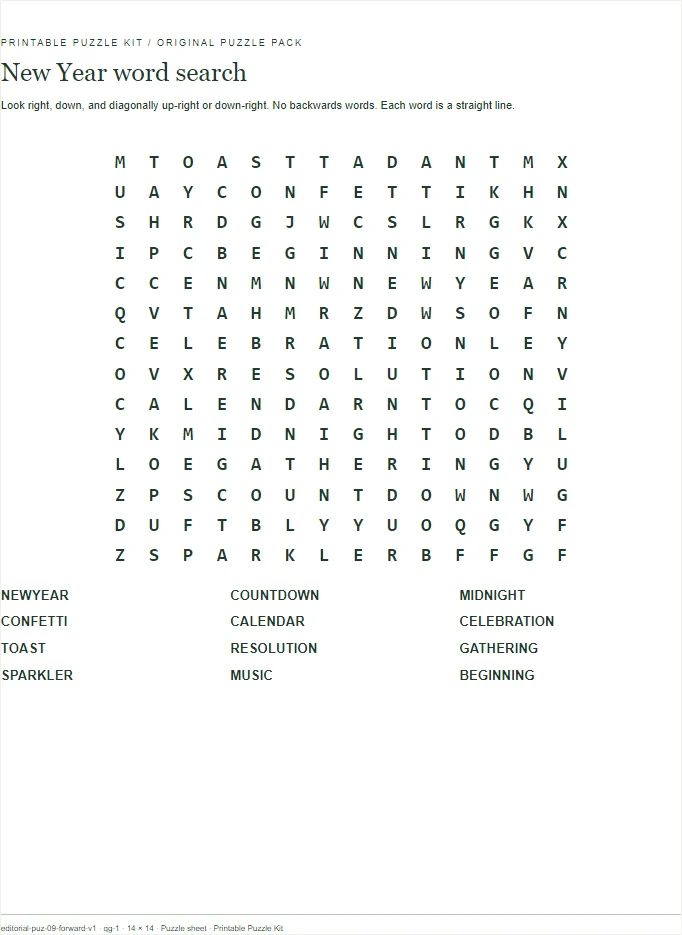
This New Year word search is a reusable celebration pack with no printed year. Two original fourteen-by-fourteen grids use twelve words about the occasion, from countdown and midnight to beginning and gathering. Each grid has matching answers and a larger-letter layout.
Open the forward New Year puzzle, forward large-print puzzle, all-directions New Year puzzle or all-directions large-print puzzle. Print the first page for solving and keep the second page as the corresponding answer sheet.
A word bank that stays useful after one calendar changes
The exact printed word bank
- NEWYEAR
- COUNTDOWN
- MIDNIGHT
- CONFETTI
- CALENDAR
- CELEBRATION
- TOAST
- RESOLUTION
- GATHERING
- SPARKLER
- MUSIC
- BEGINNING
| Search arrangement | Standard lettering | Larger lettering |
|---|---|---|
| Four forward directions | Standard forward sheet | Large forward sheet |
| All eight directions | Standard all-directions sheet | Large all-directions sheet |
The list contains New Year, countdown, midnight, confetti, calendar, celebration, toast, resolution, gathering, sparkler, music and beginning. It does not include a particular year, a dated news event or the name of a scheduled celebration. A saved pack can therefore be brought out again without updating a number in the grid.
NEWYEAR appears without a space in the puzzle. Treat it as one seven-letter entry, reading N-E-W-Y-E-A-R continuously. The normal phrase can be written with a space in prose, but there is no empty grid cell between the two words.
The theme does not require anyone to disclose a resolution or describe their plans. RESOLUTION is simply one printed sequence to find. If a group wants conversation alongside the search, participants can choose which words to discuss rather than turning the sheet into a personal questionnaire.
| Printed entry | Letters | Feature to check |
|---|---|---|
| CELEBRATION | 11 | CEL at the beginning; confirm the complete endpoint |
| RESOLUTION | 10 | RES at the beginning; confirm the complete endpoint |
| COUNTDOWN | 9 | COU at the beginning; confirm the complete endpoint |
Choose a fixed grid before preparing copies
The forward puzzle permits right, down, down-right and up-right paths. The all-directions puzzle includes the opposite paths as well, so entries can be read leftwards, upwards or along leftward diagonals. Both contain the same twelve words but place them differently.
The standard and larger-letter versions of a selected direction setting are the same puzzle. This lets two people compare finds even when one prefers more space around the letters. The print-size choice does not create an additional independent grid.
If you plan to compare answers across a group, distribute one setting consistently. If people prefer separate searches, label the two piles clearly and keep both keys. A coordinate from the all-directions solution will not necessarily point to the same word on the forward sheet.
Search celebration words by their distinctive patterns
CONFETTI contains adjacent Ts, while BEGINNING contains adjacent Ns after its opening BEGIN. These repeated pairs can act as useful anchors. Once a pair catches your eye, verify the letters on both sides instead of assuming any repeated pair identifies the whole word.
CELEBRATION and RESOLUTION share a final T-I-O-N sequence. A candidate ending may belong to either entry or to neither. Check the preceding letters along the same straight line, and keep both names in the bank until their complete paths have been confirmed.
CALENDAR is worth checking letter by letter, especially its final A-R. Familiar pronunciation can encourage an imagined spelling when the grid is crowded. The supplied bank is the reference; the letters you mark must match it exactly.
Try a bounded countdown search
COUNTDOWN has nine letters. Begin by locating Cs, then inspect the next cell in each permitted direction for O. Only continue a candidate when that second letter matches. This reduces the number of full nine-letter paths you need to inspect.
Once C-O-U-N-T is confirmed, continue through D-O-W-N without changing direction. The word’s meaning may suggest a downward path, but its actual orientation depends on the prepared grid. Do not assume a vocabulary word’s meaning controls how it was placed.
Show the COUNTDOWN positions
In the forward grid, COUNTDOWN runs right from row 12, column 4 to row 12, column 12. In the all-directions grid, it runs down from row 5, column 13 to row 13, column 13. Rows start at the top; columns start at the left.
These coordinates also provide an endpoint check. Nine letters occupy the starting cell plus eight moves, so count both the first and last cells when verifying the line. An endpoint one cell too far can make a correct word appear to contain an unwanted extra letter.
Set up a relaxed gathering activity
For an open-table version, place a few puzzle sheets beside pencils and keep the solutions separately. People can find a word, pause for conversation and return later. Crossing off the bank entry after a confirmed find preserves the group’s place without a timer.
For pairs, divide the bank into two chosen sets of six words and search the same grid together. This is an informal division of attention, not a rule that the grid itself is split into two regions. Either person may find a word assigned to the other and point it out.
A second round can use the other direction setting. Since its arrangement differs, the shared vocabulary supplies familiarity without revealing the new coordinates. Let participants know that the second sheet is a fresh search rather than a differently sized copy of the first.
Prepare the printout before the table gets busy
Before handing out copies
- Choose one arrangement and keep its matching answer sheet separately.
- Match A4 or Letter in the preview to the paper actually loaded.
- Print one proof, check the bank and grid edges, then make the remaining copies.
The two layouts use fourteen-point or eighteen-point grid letters before printer scaling. Choose portrait A4 or US Letter and inspect the preview with the actual paper size selected. Check that the word bank and identifying footer stay on the intended solving page.
Print only page one when distributing clean solving copies. Keep the matching page two nearby for checking, or print both pages for individual use if the solver is happy to manage the solution themselves. Avoid accidentally mixing the two direction settings when collecting printed pages.
If the printer reduces the larger layout to fit, the physical letters may be smaller than the original setting. Review the resulting page rather than relying only on the large-print label. No single size is guaranteed to suit every reader.
Save the correct answer with the reusable pack
The footer’s seed identifies the prepared arrangement. Keep that identifier with the answer page if you store paper copies or save the browser printout locally. The same year-neutral vocabulary can appear in many grids, so the title alone is not enough to identify a solution from elsewhere.
The supplied solutions combine highlighted paths with written start and end coordinates. Each listed word has a checked occurrence, and a separate scan of the finished grid verifies the recorded placements. The unused letters are filler; there is no promised secret message to assemble after finding the twelve entries.
For another arrangement, visit the word-search generator and use the controls it offers. Keep this page as the home of the fixed New Year pack and its hints, rather than expecting a newly generated puzzle to reproduce the coordinates above.