 Rob

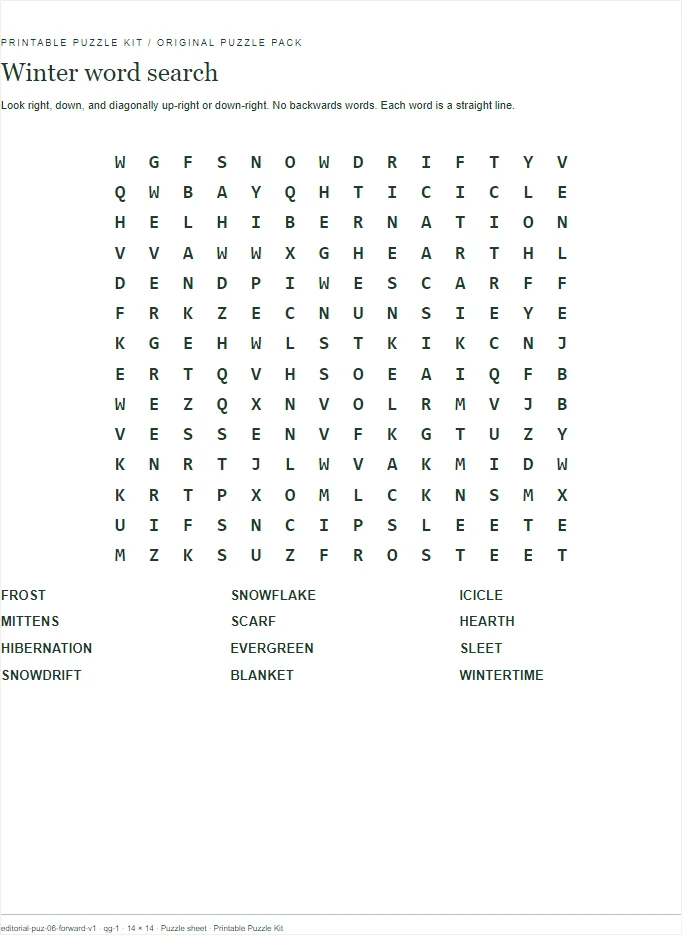
This winter word search pairs outdoor seasonal words with indoor comforts in two original fourteen-by-fourteen grids. Each has twelve listed entries, a checked answer sheet and a larger-letter option. One grid restricts the search to four forward directions; the other permits all eight directions.
Choose the forward winter sheet, forward large-print version, all-directions winter sheet or all-directions large-print version. Each file contains the solving page followed by its own solution page, ready for browser printing.
A winter theme that is separate from a holiday
The exact printed word bank
- FROST
- SNOWFLAKE
- ICICLE
- MITTENS
- SCARF
- HEARTH
- HIBERNATION
- EVERGREEN
- SLEET
- SNOWDRIFT
- BLANKET
- WINTERTIME
| Search arrangement | Standard lettering | Larger lettering |
|---|---|---|
| Four forward directions | Standard forward sheet | Large forward sheet |
| All eight directions | Standard all-directions sheet | Large all-directions sheet |
The list includes frost, snowflake, icicle, sleet and snowdrift, alongside mittens, scarf, hearth and blanket. Evergreen, hibernation and wintertime add longer sequences. There is no requirement to identify a particular holiday or connect the puzzle with a specific date.
The vocabulary is a selected winter scene, not a claim that all places experience snow or that winter falls in the same months everywhere. The pack can be used whenever its theme suits the reader. Its labels contain no year, so a saved copy does not become outdated after one season.
You do not need specialist knowledge to solve an unfamiliar entry. HIBERNATION is supplied in full in the bank, and the task is to locate that exact spelling. The puzzle makes no claim about particular animals or local weather patterns.
| Printed entry | Letters | Feature to check |
|---|---|---|
| HIBERNATION | 11 | HIB at the beginning; confirm the complete endpoint |
| WINTERTIME | 10 | WIN at the beginning; confirm the complete endpoint |
| SNOWFLAKE | 9 | SNO at the beginning; confirm the complete endpoint |
Separate words that share a beginning
SNOWFLAKE and SNOWDRIFT both begin with SNOW. Finding that four-letter fragment does not yet identify which entry, if either, is present. Continue along the same line and inspect the next letter: F begins FLAKE, while D begins DRIFT.
Mark the complete word before crossing its name off the list. If you find SNOWFLAKE, leave SNOWDRIFT unchecked even though you have found a word beginning with the same four letters. The finished grids have separate checked occurrences of the listed entries.
WINTERTIME is another compound-style sequence that can be searched in pieces. Looking for TIME may reveal a candidate, but the preceding letters must form WINTER continuously. A matching ending by itself can also appear as filler, so verify both sections.
Use this pack to practise upward diagonals
In the forward setting, words may run right, down, diagonally down-right or diagonally up-right. The last option deserves attention: as you read the letters in order, the column number increases while the row number decreases. It is an allowed forward path because it moves towards the right.
The forward SNOWFLAKE provides a concrete example if you want one. It begins near the bottom of the grid and rises as it travels right. Following the line involves moving one row up and one column right for each next letter, keeping a constant diagonal slope.
Reveal the forward SNOWFLAKE path
SNOWFLAKE starts at row 14, column 4 and runs diagonally up-right to row 6, column 12. There are nine letters, so the endpoint is eight diagonal steps from the start. This hint applies to both print sizes of the forward winter grid.
The number of steps is one fewer than the number of letters because the starting cell already contains the first letter. Keeping that distinction in mind helps when checking an endpoint from the answer list.
Approach repeated letters deliberately
MITTENS has consecutive Ts, while EVERGREEN contains several Es separated by other letters. These patterns call for different checks. For MITTENS, look for a pair of adjacent Ts on a possible path. For EVERGREEN, keep the complete letter order visible rather than simply counting how many Es appear nearby.
ICICLE alternates small letter groups that can look convincing at a glance. Read I-C-I-C-L-E in full. A run that stops after ICIC is only a partial match, and a misplaced final vowel cannot be repaired by stepping sideways off the line.
For the short entry SCARF, scan candidate Ss systematically. Short words offer fewer distinctive letters than HIBERNATION, so checking every possible first-letter position may be more reliable than waiting for the whole word to stand out visually.
Switch direction settings without changing the vocabulary
The all-directions sheet allows backwards rows, upward columns and leftward diagonals in addition to the forward paths. It uses a different arrangement, so completing the forward puzzle does not supply the second grid’s answers.
If searching backwards feels unfamiliar, keep the target spelling on the page and trace from a plausible first letter in the opposite direction. Reading a row visually from left to right may show the word’s letters reversed, but the correct solution still spells the entry from its recorded start to its finish.
These settings describe the available paths rather than measured difficulty levels. A reader can choose fewer directions for a more bounded search or all directions for more possibilities to inspect. Larger print is available for either choice.
Print a sheet that leaves room to mark the paths
Before handing out copies
- Choose one arrangement and keep its matching answer sheet separately.
- Match A4 or Letter in the preview to the paper actually loaded.
- Print one proof, check the bank and grid edges, then make the remaining copies.
Standard grid letters are set at fourteen points and larger letters at eighteen points before scaling. Preview in portrait A4 or US Letter and check the full grid and word bank. Actual printer settings can change the final size, so inspect what will fit on your chosen paper.
For a monochrome print, the solving grid remains plain black lettering. The solution uses marked cells and written coordinates together. If light shading is faint, the start and end positions still identify each line without requiring colour recognition.
A pencil lets you adjust a mistaken circle without hiding a crossing word. If you prefer a highlighter, use a light stroke and check that the letters beneath it remain legible. The objective is to preserve enough information to verify the remaining entries.
Use the answer page as a controlled check
When one entry remains, cover most of the solution list and reveal only that word’s starting position. A starting cell leaves the direction and full sequence for you to confirm. The complete highlighted grid is available if you prefer to finish with a direct check.
Match the direction label and seed before using the key. Standard and larger print share answers within one setting, but the forward and all-directions keys are different. Keeping the sheet identity visible avoids treating a correct coordinate from the other grid as a printing fault.
Each prepared grid was independently scanned against its listed words and coordinates. For a new arrangement, use the word-search generator; for this winter pack, keep the supplied solution with the original printable so the checked paths remain easy to identify.