 Rob
A hidden pair in Sudoku is found by following two digits through one row, column or box. If both digits can appear only in the same two cells of that group, those cells must contain the two digits in some order. Remove every other candidate from those two cells.
Open the original hidden-pair practice pack. It contains a complete candidate grid, the marked deletion, the updated state and a separate puzzle and solution. The example uses two and five in row three, with three specific candidates removed. All of the coordinates and reasoning are explained below.
Look for digit locations, not small candidate lists
The standard rule is described in HoDoKu’s hidden-subset documentation: two digits confined to the same two cells of a house reserve those cells, allowing other candidates there to be removed. A house is one row, column or three-by-three box.
A hidden pair can sit inside cells with several candidates, which is why it may not look like a pair at first. You are not searching for two small notes that happen to match. You are checking every possible location for each of two digits within one group.
The restriction is local to that group. The same digits may appear as candidates in many other rows or boxes. Their existence elsewhere does not invalidate the pair. What matters is whether either digit has an additional possible position inside the particular row, column or box you are examining.
Get oriented in the example
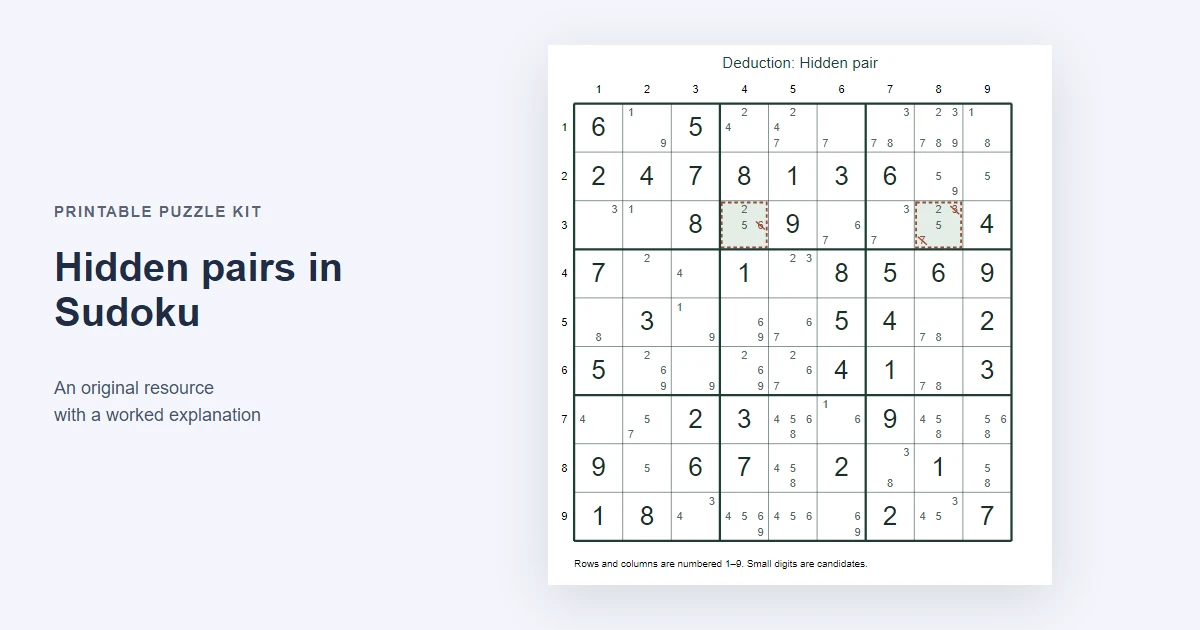
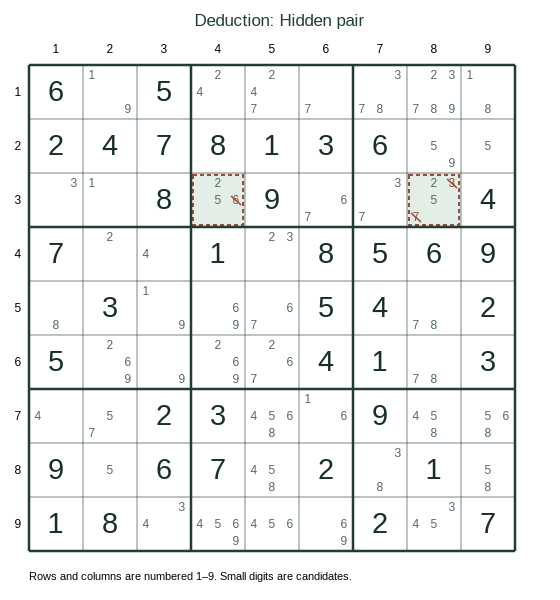
Rows and columns are numbered one through nine. Our pair cells are r3c4 and r3c8: row three, columns four and eight. The heavy grid lines mark the boxes. The two cells share row three but belong to different boxes.
This teaching state is the original puzzle with all initial candidates filled in. There are no prior candidate eliminations to reconstruct. You can verify every initial note by checking the digits already placed in its row, column and box.
Other simple deductions are visible in the grid, including cells with only one candidate. We deliberately focus on the hidden pair to illustrate the technique. The puzzle does not require you to use this particular move first, and finding an easier step does not make the pair invalid.
List all the possible positions in row three
Checked candidate changes in this teaching state
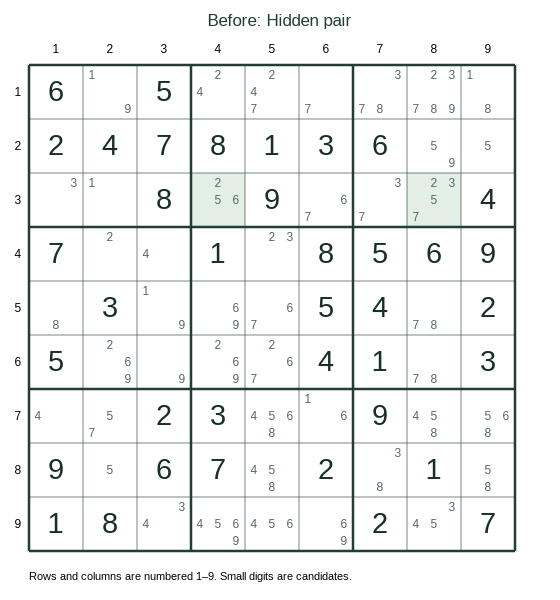
| Cell | Before | Remove | After |
|---|---|---|---|
| r3c4 | 2, 5, 6 | 6 | 2, 5 |
| r3c8 | 2, 3, 5, 7 | 3, 7 | 2, 5 |
Row three already contains eight at column three, nine at column five and four at column nine. Its other cells have these candidate lists: r3c1 has three; r3c2 has one; r3c4 has two, five and six; r3c6 has six and seven; r3c7 has three and seven; r3c8 has two, three, five and seven.
Track candidate two across that complete row. It appears at r3c4 and r3c8 and nowhere else. Now track candidate five. It appears at exactly the same two positions, again with no other possible location in row three.
Write the observation in a compact form if useful: “row three: two → c4 or c8; five → c4 or c8”. This records the actual evidence. Saying “these cells both have two and five” omits the crucial check that neither digit can go elsewhere in the row.
Prove why the extra candidates must go
Row three needs both a two and a five. Each can occupy only r3c4 or r3c8. There are two required digits and exactly two available cells for them, so those cells are reserved. One must hold two and the other five.
Suppose r3c4 were six, one of its current extra candidates. Then both two and five would need to occupy r3c8, which cannot hold two values. Six is therefore impossible at r3c4. The same argument excludes any non-pair digit from either reserved cell.
At r3c8, the extra candidates are three and seven. If that cell held either one, both two and five would have to go in r3c4. That is equally impossible. Remove three and seven from r3c8.
The exact result is r3c4 reduced from two–five–six to two–five, and r3c8 reduced from two–three–five–seven to two–five. The hidden pair is now visible as two identical two-candidate cells. It still does not tell you which cell is two and which is five.
Check the immediate consequence
Before the pair deduction, candidate six in row three appears at r3c4 and r3c6. Removing six from r3c4 leaves r3c6 as its only possible location in that row. You can therefore place six at r3c6 as a separate follow-on deduction.
Notice that r3c6 still displays six and seven immediately after the pair update. The placement is justified by six having only one position in the row, rather than the cell having only one candidate. That distinction separates a hidden single from a naked single.
The printable “after” page stops after the pair’s three deletions. Use it to find this next step yourself. If you place the six, update its row, column and box before looking for another pattern. Each new placement changes the candidate information you are relying on.
Compare it with a naked pair
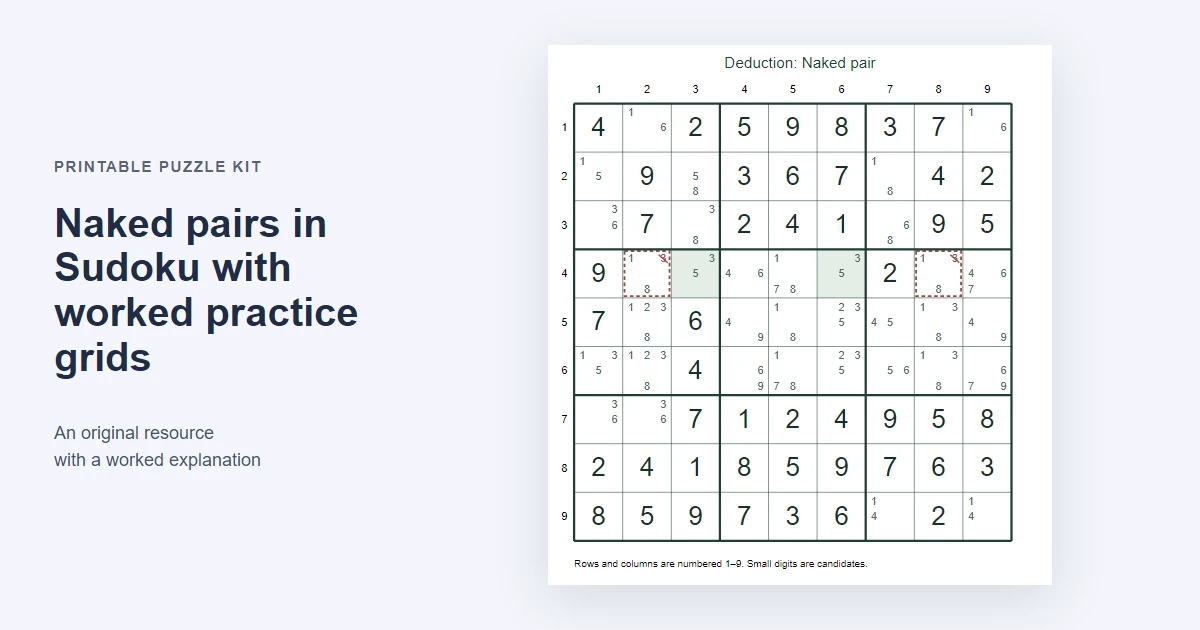
For a naked pair, you begin with two cells that each contain only the same two candidates. Those cells reserve the digits, allowing them to be removed from other cells in the shared group. The naked-pair guide demonstrates three and five at r4c3 and r4c6 in a different checked puzzle state.
For this hidden pair, you begin with two digits that have only the same two possible positions in a group. The reserved cells may contain extra notes, and the deduction removes those extra notes from the cells themselves. You are tracking positions of digits instead of starting with the length of a cell’s candidate list.
A useful question is “where does the deletion happen?” With a naked pair, look outside the pair cells but inside the shared group. With a hidden pair, look inside the pair cells and remove the other digits. This is a practical check on whether you have applied the rule in the correct direction.
After a hidden pair is cleaned up, it also looks like a naked pair. That does not mean the original evidence was the same. Before deleting six, three and seven, our two cells contained different longer lists. The fact that two and five had no other row positions justified changing those lists.
Check the near-misses
Near-miss: a third possible position
Imagine a candidate-location example in which two can go at columns four or eight of a row, but five can go at columns four, seven or eight. That is not a hidden pair of two and five at columns four and eight. Five could occupy column seven, so the two chosen cells are not both reserved for the pair.
This is a hypothetical pattern comparison, not an additional published puzzle. Its purpose is to show exactly which condition is missing. You would need another justified deduction to remove five from column seven before the two-position argument could apply.
Do not stop scanning when you have found two appealing locations. Search the entire group for both digits. One overlooked candidate near the other end of a row can invalidate the proposed pair even if the two highlighted cells look convincing.
Near-miss: each digit has two positions, but they differ
Suppose two can occupy columns four or eight, while five can occupy columns four or seven. Each digit has two possible locations, but the sets do not match. Across both digits there are three positions, not a single shared pair of cells.
The common position at column four does not force both digits into the same two cells. Two could be at eight while five is at seven. Therefore you cannot use the hidden-pair rule to remove other candidates from column four or either of the other cells.
When making a location list, compare the cell names rather than only the number of occurrences. “Two places each” is necessary for this particular pair search, but “the same two places” is the condition that creates the reservation.
Near-miss: incomplete or stale notes
If a legitimate candidate was never written into a third cell, the notes can create a false hidden pair. Conversely, an old candidate left behind after a placement may conceal a real pair. Both problems come from the record describing a different state from the actual puzzle.
Check candidate completeness before using the technique. For a fresh grid, derive notes from all placed digits. For an intermediate grid, preserve earlier justified eliminations as well. Rebuilding every candidate only from the placed digits can accidentally restore possibilities that a previous pair or locked-candidate deduction already removed.
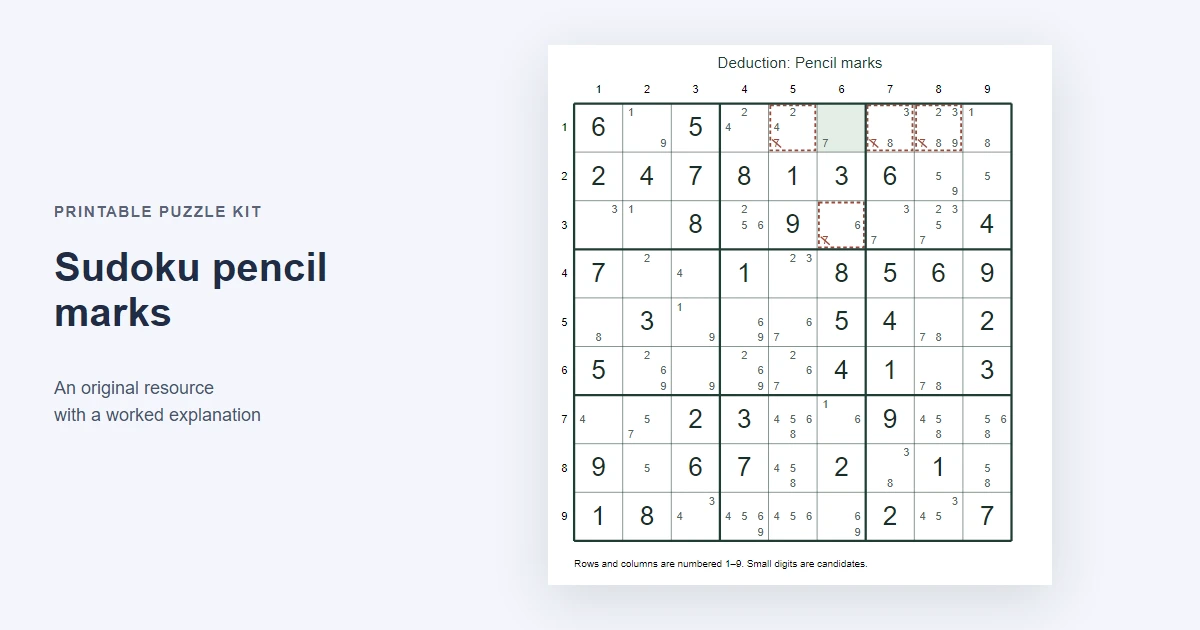
The pencil-mark guide demonstrates the basic update loop. If you lose track during a longer solve, return to a state you can justify and replay the changes rather than treating an uncertain list as complete evidence.
Search one group systematically
The example also shows why you must keep the reservation inside its stated group. At r6c4, the starting candidates are two, six and nine. That cell shares column four with r3c4 but shares no group with r3c8. The row-three hidden pair gives no reason to remove two from r6c4. The checked solution in fact places two there.
To see the distinction without using the answer, imagine row three’s two going into r3c8 and its five into r3c4. That arrangement would not place a two in column four, so it would not exclude two at r6c4. Because the hidden-pair proof does not decide which pair cell holds two, it cannot support the proposed deletion outside the row.
You may later find an additional pattern involving one of these cells, but write its proof separately. Combining several vaguely remembered restrictions can make an invalid move feel persuasive. A useful deduction note names the group and states exactly what it reserves. For this exercise, “row three reserves two and five at columns four and eight” is sufficient; it says nothing about banning those digits throughout either column.
Choose a row with several unresolved cells. List the possible positions for each missing digit. Look for two digits whose position lists contain exactly the same two cell names. Then inspect those cells for extra candidates that the reservation would remove.
Repeat the process for columns and boxes. The logic does not change, but the group boundary does. In a box, the two cells may lie in different rows and columns; their shared box is enough to support the hidden-pair reservation within that box.
If the two reserved cells already contain only the pair digits, there is no extra candidate to delete there. You have recognised a useful structure but have not changed the state through the hidden-pair cleanup. Look for an actual consequence before recording it as a solving step.
Use a short practice sequence
First, cover the marked diagram and inspect only the “before” page. Write every position for two and every position for five in row three. Check that the lists match exactly, then name the three candidates that must be removed.
Second, explain one deletion by contradiction. For example, assume six at r3c4 and ask where row three’s two and five would go. You should reach the problem of two required digits competing for one remaining cell, without consulting the completed solution.
Third, compare your updated notes with the “after” page and find the only remaining row-three position for six. This separates the pair deduction from the next placement. You can then continue the original puzzle or choose a fresh printable Sudoku for another candidate-location search.
Printing and verification
Print the pages you need on A4 or Letter in portrait orientation, using the browser preview to check size and margins. The solution is on its own page. The diagrams are vectors, so you can enlarge them on screen without making the lines blurry; the small notes still need a comfortable viewing size.
The original puzzle has exactly one solution according to a separate exact-cover checker. The two candidate-location lists were checked against the supplied state, and forcing any of the three removed values produced no valid completion. These are checks of this original example, not a claim that every apparent pair in an unchecked puzzle is valid.
Keep the central test simple: two required digits, the same two positions, one shared group. Once that is established, the extra notes inside those cells must go, while the two pair digits remain unresolved until another deduction distinguishes them.