 Rob
Pointing pairs and claiming are two directions of the same Sudoku idea: a digit is confined to the intersection of a box and a line. That reservation can remove the digit from other cells in the line or the box. You can make the deletion without knowing which of the remaining positions holds the final value.
Open the original pointing-pair pack and the separate claiming practice pack. Both contain checked puzzles, full candidate diagrams, marked deductions and matching solutions. The first uses seven in the centre box; the second uses three in row five.
Two directions through one intersection
| Pattern | Check first | Remove from |
|---|---|---|
| Pointing | All positions for a digit in one box lie in one row or column | That line outside the box |
| Claiming | All positions for a digit in one row or column lie in one box | That box outside the line |
HoDoKu’s intersections guide distinguishes pointing, where a box’s candidates are restricted to one line, from claiming, where a line’s candidates are restricted to one box. Both are commonly described as locked candidates.
For pointing, start with a box. If every possible position for a digit in that box lies in the same row or column, the digit must occupy that line inside the box. Remove it from the rest of the line outside the box.
For claiming, start with a row or column. If every possible position for a digit in that line lies inside one box, the line must place the digit there. Remove it from the other cells of that box outside the line.
The direction determines where you check for complete coverage and where you delete. A useful note names both: “box five to column five” or “row five to box four”. That is more precise than simply circling some candidates and writing “locked”.
Pointing example: seven in the centre box
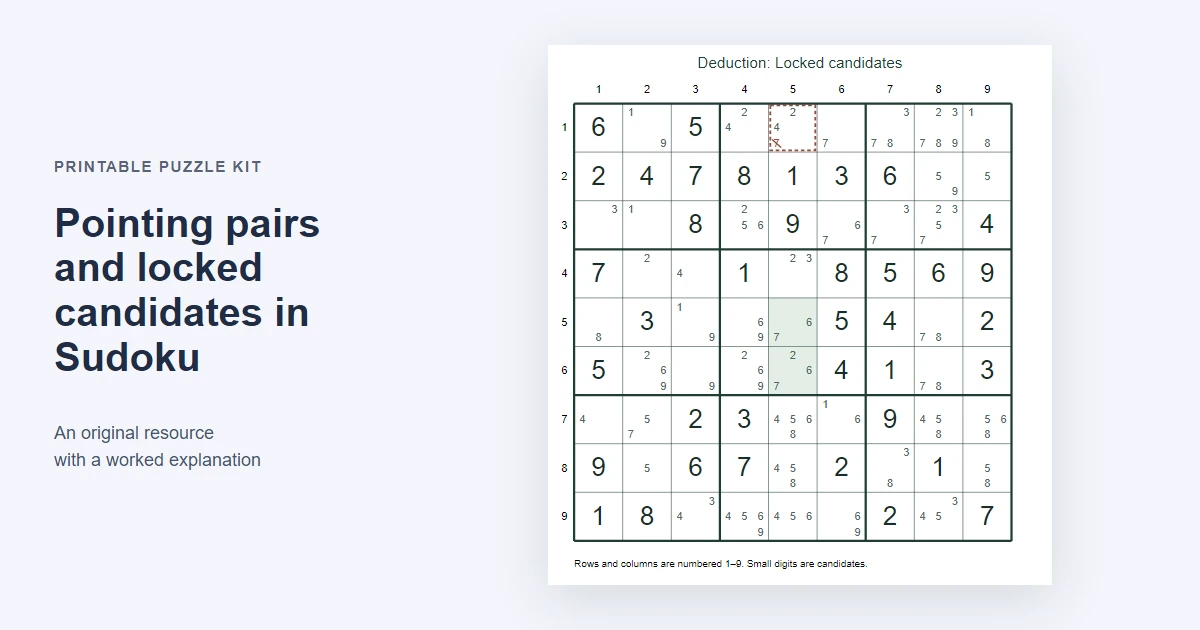
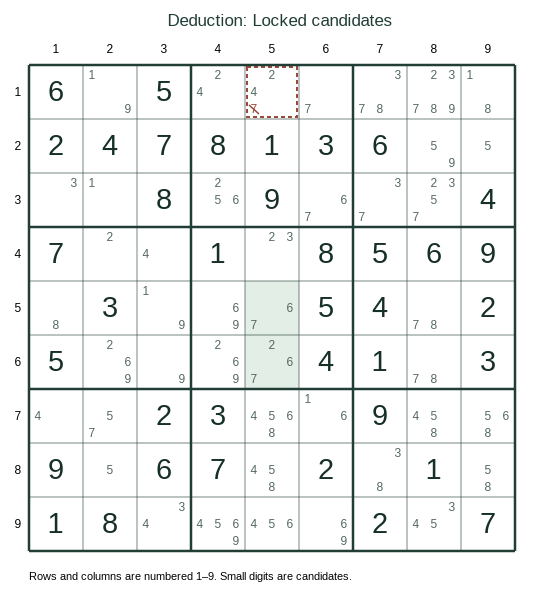
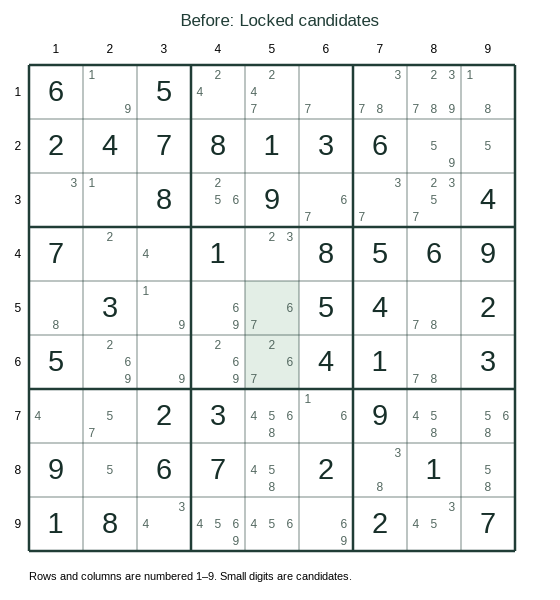
In the first pack, look at box five, the centre three-by-three box covering rows four through six and columns four through six. The only possible positions for seven inside that box are r5c5 and r6c5. Both lie in column five.
At this starting state, r5c5 has candidates six and seven. r6c5 has two, six and seven. Those lists do not form a naked pair because they differ and one has three candidates. Pointing follows the locations of a single digit, so the extra possibilities do not invalidate the seven reservation.
Check every other cell in the centre box. None can contain seven according to the complete current notes. That full-box check is essential. Two sevens aligned in a column do not establish the pattern if a third possible seven exists elsewhere in the same box.
Prove and apply the pointing deletion
Checked candidate changes in this teaching state
| Cell | Before | Remove | After |
|---|---|---|---|
| r1c5 | 2, 4, 7 | 7 | 2, 4 |
The centre box requires one seven. It must go in one of the two highlighted cells. Whichever cell takes it, column five will already contain its seven inside the centre box. No other cell in column five can then contain seven.
In the supplied grid, r1c5 is the one outside-box cell in that column with a seven candidate. Its list is two, four and seven. Remove seven, leaving two or four. The marked diagram crosses out that specific candidate and leaves the two source sevens intact.
You can also prove the deletion by assuming the opposite. If r1c5 were seven, column five would exclude seven from both r5c5 and r6c5. The centre box would then have nowhere to put seven. Because that violates the box requirement, seven cannot occupy r1c5.
The move does not choose between r5c5 and r6c5. It also does not place a value at r1c5, which still has two candidates. A useful elimination can narrow the grid without immediately producing a solved cell. Keep the distinction between removing a possibility and proving a placement.
Claiming example: three in row five
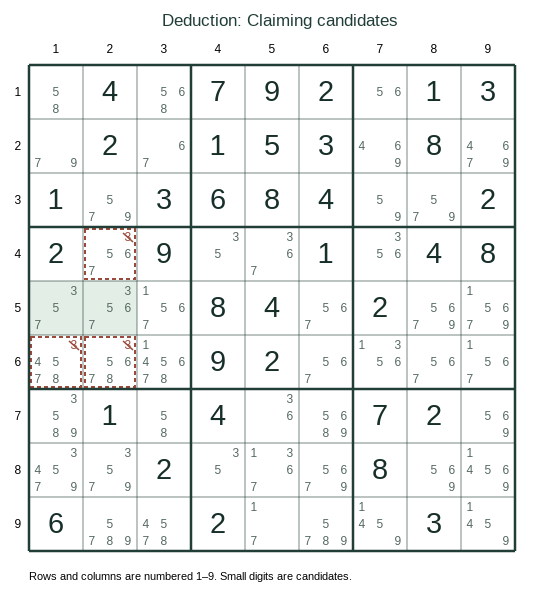
The second pack uses a different original puzzle and an intermediate state after thirteen recorded deductions. Row five can place three only at r5c1 or r5c2. Both cells lie in box four, the middle-left box covering rows four through six and columns one through three.
Here the complete check starts with the row. Inspect all nine cells in row five and confirm that no other unresolved cell contains candidate three. The two highlighted cells can contain other digits; the argument concerns where row five’s required three can go.
At this state, r5c1 has candidates three, five and seven. r5c2 has three, five, six and seven. They are not identical two-candidate cells, and they do not need to be. Their shared box is what allows the row’s reservation to affect other cells.
Because row five must place its three somewhere, box four will receive a three in r5c1 or r5c2. Therefore the other cells in that box, outside row five, cannot contain three. You have moved from a line restriction to a box exclusion.
Make the three claiming eliminations
In the supplied state, three is removed from r4c2, r6c1 and r6c2. Before the move, r4c2 contains three, five, six and seven; afterward it contains five, six and seven. r6c1 changes from three, four, five, seven and eight to four, five, seven and eight.
The third target, r6c2, changes from three, five, six, seven and eight to five, six, seven and eight. No other digit is removed from those cells by this deduction. The two highlighted source cells in row five keep their three candidates.
For a contradiction proof, assume three at r4c2. Because that cell belongs to box four, it would exclude three from both r5c1 and r5c2. Row five would then have no place for three. The same argument works for either of the other two target cells.
Compare what stays and what goes
In the pointing example, the source is a box and the destination is a column. The source candidates remain inside the box; the removed seven is farther along the column. In the claiming example, the source is a row and the destination is a box. The source candidates remain in the row; the removed threes are elsewhere inside the box.
Do not delete the very candidates that establish the reservation. The two source cells are the possible places where the required digit will go. Removing the digit from both would destroy the group’s last valid positions.
Likewise, do not remove unrelated candidates from the target cells. Pointing seven at r1c5 does not justify choosing between two and four. Claiming three in box four does not remove five, six, seven or eight there. Every deletion should follow the specific digit and group boundary in the proof.
Pointing pairs, triples and singles
A box can have two or three possible positions for a digit aligned in one row or column. With two positions, the pattern is often called a pointing pair; with three, a pointing triple. The same reasoning works because every possible position inside the box lies on the one line.
If the box has only one possible position for the digit, you can place it directly as a hidden single. That placement then removes the digit from its peers. You do not need to treat a direct placement as a more elaborate pointing pattern.
The number of candidates written in each source cell is a different quantity. A pointing pair means two locations for one digit, not two candidates in each cell. Our r6c5 contains three candidates and is still one of the two seven locations supporting the pointing deduction.
Check the near-misses
Near-miss: an extra position in the source group
Suppose the centre box also allowed seven at a cell in column four. The box’s seven could then go there, leaving column five free to place seven outside the box. The two aligned seven candidates in column five would no longer support the pointing deletion.
This hypothetical change explains why the source-group scan must be complete. It is not enough to notice two candidates in a straight line. Confirm that all possibilities for the digit in the box lie on that line before removing anything beyond it.
For claiming, reverse the test. If row five had another possible three outside box four, its three could go there. The row would no longer guarantee a three inside box four, so the proposed box eliminations would lack their justification.
Near-miss: treating every nearby cell as a target
In the pointing example, a seven candidate elsewhere in row one is not removed merely because r1c5 loses seven. The reservation concerns column five, not the whole row containing the target. A candidate deletion does not behave like a placed digit and automatically clear its surrounding groups.
Similarly, the claiming move removes threes only from box four outside row five. It does not remove three from every cell in rows four and six. Those rows cross other boxes where the digit may remain entirely possible.
Trace the intended boundary with a finger or light outline before erasing. For pointing, follow the line beyond the source box. For claiming, inspect the destination box outside the source line. The geometry of the target region should match the verbal proof.
Search systematically using one digit
Choose a digit and inspect its candidate positions box by box. If a box’s positions all share a row or column, inspect the rest of that line for actual eliminations. A valid alignment with no target candidates is a recognised restriction but does not change the current notes.
Then inspect rows and columns for the reverse pattern. If all positions for the digit in one line fit within a single box, check the other cells of that box. Keep a clear starting group so you do not accidentally combine part of a box scan with part of a row scan.
After a deletion, update the notes and check for singles. A new placement may create further intersections or other patterns. Return to the simple consequences before searching the whole grid for another advanced-looking arrangement.
Practise with the two supplied states
If your own notes differ from a teaching page, first check that you are comparing the same stage. The pointing example uses initial candidates from its original givens. The claiming example follows thirteen earlier moves in a different puzzle. Copying the original givens of the second puzzle and immediately expecting the claiming diagram’s notes would skip that recorded history.
For a focused lesson, begin directly from the supplied candidate state and verify the local restriction shown there. For a full solve, begin from the original puzzle and accept that your sequence may reach different intermediate states. Both activities are legitimate, but they answer different questions. One practises a named deduction; the other explores how a whole puzzle unfolds.
Keep earlier candidate eliminations when reconstructing a state. A placed digit removes candidates from its peers, while a prior pair or intersection may remove a candidate even though no new large digit appears nearby. Restoring every digit allowed by visible givens alone can undo that earlier logical work. If the history is uncertain, use the prepared state for this exercise and keep your independent solve on a separate sheet, clearly labelled with its seed.
Begin with the pointing “before” page and cover the marked diagram. Write the source group, all source positions, the destination line and the target candidate. Your note should identify box five, r5c5 and r6c5, column five, and seven at r1c5.
Repeat with the claiming page. Identify row five as the source, r5c1 and r5c2 as its two positions for digit three, box four as the destination, and r4c2, r6c1 and r6c2 as targets. Explain why placing three at any target would leave row five without a three.
Use the pencil-mark guide if candidate updates are unfamiliar. To compare a two-digit reservation with this single-digit intersection, work through the naked-pair and hidden-pair examples afterward.
Print and verify the examples
Each pack has five separate pages, including the original puzzle and solution. Choose A4 or Letter portrait and inspect the preview. Print only the teaching pages for a focused technique exercise, or keep the original puzzle and answer separate for a full solve.
Both original puzzles have exactly one solution according to an independent exact-cover checker. The source-group restrictions and target positions were checked, and forcing any shown eliminated value produced no valid completion. The claiming state’s prior deductions are preserved with the resource so its candidate notes have a recorded history.
These checks confirm the supplied examples. When applying the technique to another printable Sudoku, verify the current notes and the complete source group yourself. The reliable habit is to state where the digit must go, then remove it only from the places that conflict with every remaining source position.