 Rob
A naked pair in Sudoku consists of two empty cells in the same row, column or box, each containing exactly the same two candidates and no others. Those two digits must occupy those two cells in some order. You can remove both digits from every other cell in the shared group, even before you know which member of the pair goes where.
Open the original row-pair practice pack, or open the same checked example transposed into a column. Each pack includes the candidate state, marked eliminations, the updated state, the original puzzle and its solution. The row and column versions are deliberately related so you can compare the same reasoning in two orientations.
The rule, with its limits
HoDoKu’s naked-subset documentation describes the standard pair rule: two cells in a shared house with only the same two candidates reserve those digits within that house. Here, a house means a row, column or three-by-three box.
The word “only” matters. A cell with three, five and eight is not one half of a naked three–five pair. The word “shared” matters too. Two cells with three and five in unrelated parts of the grid do not reserve the digits in a common group.
The deduction removes candidates elsewhere; it usually does not solve the pair immediately. Keep both possibilities in both pair cells until another rule distinguishes them. Writing three into one and five into the other because that arrangement looks convenient turns a valid elimination into an unsupported guess.
Read the supplied practice state
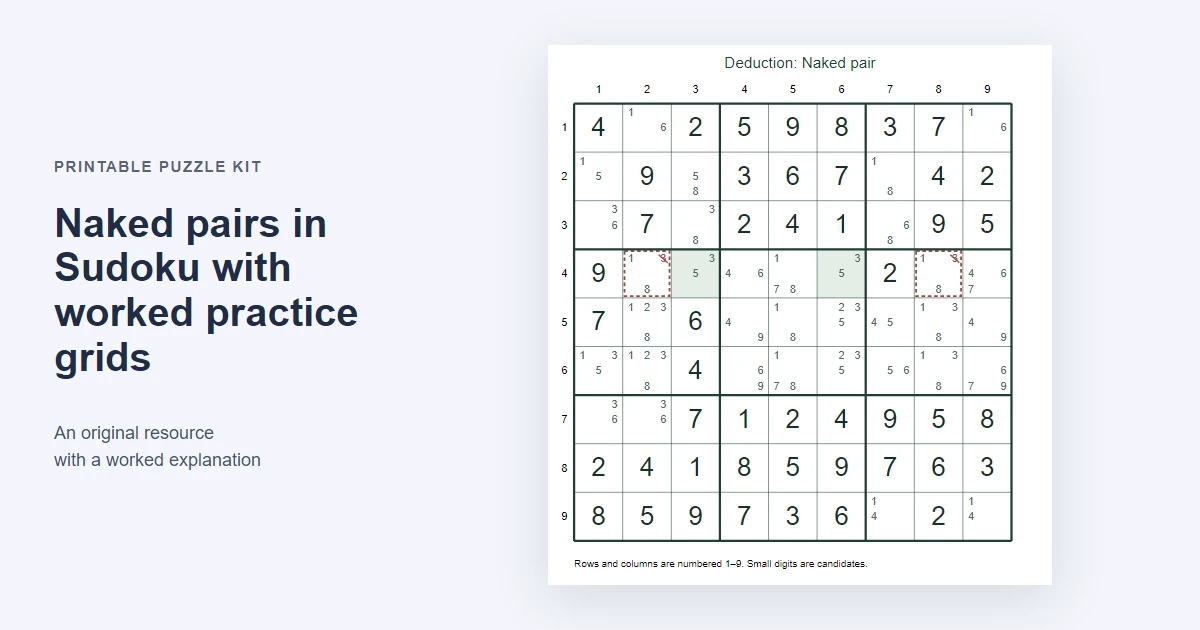
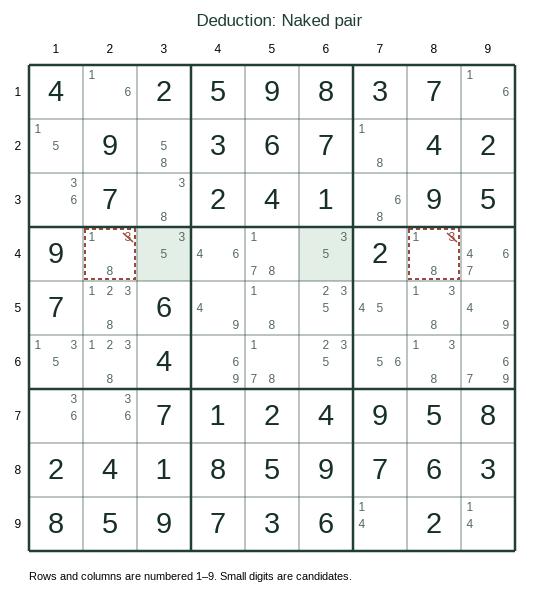
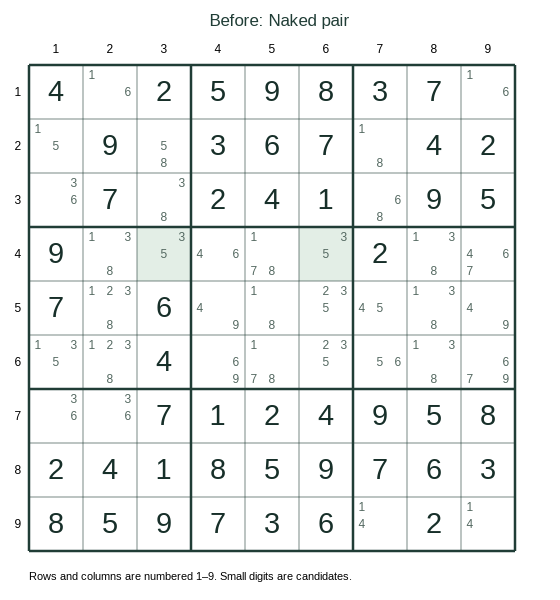
The main example focuses on row four. The two pair cells are r4c3 and r4c6, meaning row four column three and row four column six. Each has exactly the candidates three and five. They share row four but belong to different boxes.
This is an intermediate state of the original puzzle, after nineteen recorded deductions. Some candidates have already been removed logically, so the complete candidate notes cannot all be reconstructed from the visible placed digits alone. Start from the supplied “before” page when practising this particular pair.
If you prefer to solve from the beginning, use the original-puzzle page and keep the teaching pages aside. You may find a different valid sequence of deductions. The practice state demonstrates one justified step; it does not claim to be the only possible route through the puzzle.
Prove the reservation before deleting anything
- Check that r4c3 and r4c6 each contain exactly {3,5} and share row four.
- If the first is 3, the second is 5; if the first is 5, the second is 3. The row reserves both digits in those cells.
- Remove 3 from r4c2 and r4c8, the other row cells containing it. Neither contains 5, so no 5 is deleted there.
Checked candidate changes in this teaching state
| Cell | Before | Remove | After |
|---|---|---|---|
| r4c2 | 1, 3, 8 | 3 | 1, 8 |
| r4c8 | 1, 3, 8 | 3 | 1, 8 |
Consider the two possibilities for r4c3. If it is three, r4c6 cannot also be three because both cells share a row. Since r4c6 has only three and five available, it must then be five. If r4c3 is five, the same reasoning makes r4c6 three.
In either case, row four’s three and five are used by those two cells. A different cell in that row cannot take either digit without creating a duplicate. That conclusion holds without deciding which of the two arrangements is the final one.
This proof is local. It uses the complete candidate lists of the pair cells and the row’s no-duplicate rule. You do not need to inspect the answer sheet to justify it, and you do not need to try each arrangement through the rest of the puzzle.
Make the two eliminations in this example
Before the deduction, r4c2 contains one, three and eight. Because the pair reserves three in row four, remove three from r4c2. Its remaining candidates are one and eight. There is no five there to remove, so the pair does not create an additional change in that cell.
The same change occurs at r4c8. It begins with one, three and eight and becomes one or eight. Those are the only candidate deletions produced by this pair in the supplied row. The other row-four cells do not contain a removable three or five.
In particular, r4c4 remains four or six, r4c5 remains one, seven or eight, and r4c9 remains four, six or seven. The placed nine at r4c1 and two at r4c7 are unchanged. Listing the unchanged cells helps separate the exact deduction from an impression that the entire row should suddenly be solved.
The two newly reduced cells now form another naked pair, one and eight, in row four. That is a separate observation made after the first update. It allows one and eight to be removed from r4c5, leaving seven there. You can verify that follow-on step using the “after” page; the first marked diagram shows only the original three–five eliminations.
Compare the column version
The second pack transposes the same puzzle: rows become columns and columns become rows. The three-by-three box structure is preserved, so the transformed puzzle remains a valid Sudoku with a matching transformed solution. It is an orientation exercise, not an unrelated second puzzle.
The pair is now at r3c4 and r6c4 in column four. The candidates are still three and five. They reserve those digits in column four, so three can be removed from r2c4 and r8c4. Both affected cells again become one or eight.
Read the proof with “column four” replacing “row four”. One pair cell must take three and the other five. Therefore no other cell in that column can take either digit. The grid’s orientation changes the coordinates, not the logical requirement.
After checking the two versions, cover the marked pages and explain both deductions aloud or in a margin note. State the group, the pair cells, the two reserved digits and the exact cells that lose candidates. A complete explanation is more reliable than recognising a familiar-looking shape.
Three near-misses that are not naked pairs
One cell has an extra candidate
Suppose two cells in a row contain three–five and three–five–eight. The second cell might be eight, leaving either three or five to appear elsewhere in the row. The two cells therefore do not reserve three and five through the naked-pair rule. Check for another deduction rather than deleting the extra eight because you want a pair.
The cells share no group
Suppose r1c1 and r9c9 both contain three and five. They share neither a row, a column nor a box. They can both be three in a completed grid without breaking a shared-group rule between them. Matching candidate lists alone are not enough to justify eliminations.
The notes are incomplete
If you wrote only the candidates you noticed first, two apparent three–five cells might still allow another digit. A naked-pair proof requires complete current possibilities for those cells. Recheck the notes or use a supplied full candidate state before applying the rule.
When the pair shares two groups
Sometimes both pair cells lie in the same row and the same box, or the same column and the same box. The reservation then applies separately in each shared group. Other cells in that row or column can lose the pair digits, and other cells in the box can lose them too.
Check each target cell against a group shared by both pair cells. A target that sees only one member of the pair does not automatically lose both digits. In the main example, r4c3 and r4c6 lie in different boxes, so their pair gives row eliminations only.
A useful way to avoid overreach is to outline the shared group before marking candidates. Then inspect only its other cells. If the pair also shares a second group, outline that separately and repeat the check. The visual boundary should match the proof.
Find pairs without scanning randomly
The supplied grid contains a concrete example of a cell outside the pair’s shared row: r6c6 has candidates two, three and five at this stage. It shares column six and the middle box with r4c6, but it shares no group with r4c3. You cannot delete three and five there merely because it sees one member of the pair.
Why does the proof fail for that target? The pair might resolve as r4c3 equal to five and r4c6 equal to three. In that case, r6c6 cannot be three because of its column, but the pair gives no reason to exclude five there. In fact, the checked solution places five at r6c6. The solution illustrates the danger; the failed shared-group condition is the reason to reject the deletion before looking at the answer.
Keep this distinction in your deduction notes. “Pair three–five in row four” identifies the valid scope. “Delete three and five near these cells” does not. If a candidate is being removed from a different row, name the second group shared by both pair cells, or find another explicit rule that justifies the step. Physical closeness on the page is not a Sudoku constraint.
Begin with cells that have exactly two candidates. Compare them within their row, then column, then box. You are looking for the same two digits, not merely one digit in common. A three–five cell and a three–eight cell are different pairs of possibilities.
Once you find a match, inspect the remaining cells of the shared group. A valid pair may produce no new deletion if its digits are already absent elsewhere. In that case, it is a useful reservation to understand but not a step that changes the current candidate state.
After any deletion, return briefly to simpler checks. A new single or another pair may have appeared, as happens in row four of this example. You do not need to keep searching for a more elaborate pattern when the update has already created a straightforward next move.
Naked pairs and hidden pairs
| Pattern | What is restricted | What is removed |
|---|---|---|
| Naked pair | Two cells each contain only the same two candidates | Those candidates elsewhere in the group |
| Hidden pair | Two digits can occur only in the same two cells | Other candidates inside those cells |
A naked pair starts with two cells whose complete candidate lists contain only the same two digits. A hidden pair starts by tracking two digits that can occur only in the same two cells of a group, even though those cells contain other candidates.
The direction of deletion differs. The naked pair removes its digits from other cells in the group. The hidden pair removes the extra candidates from the two reserved cells. Both rely on the same requirement that each digit appear once in the group, but the evidence you inspect is different.
If these descriptions blur together, revisit the pencil-mark guide and practise describing one cell’s full candidate list. Clear notes make the distinction much easier to test on a real grid.
Print, practise and check
Choose A4 or Letter portrait and inspect the print preview. Each pack has five pages; the original puzzle and solution are separated from the teaching states. Candidate notes are smaller than placed digits, so avoid excessive printer scaling. The vector diagrams can also be enlarged on screen.
The original givens and the transposed version were each checked for exactly one solution with an independent exact-cover solver. Each displayed elimination was checked by forcing the removed digit and confirming that no valid completion remained. The pattern conditions were checked separately, so a correct answer alone is not being used as a substitute for the pair proof.
Try the row example first, then the column version, then return to a fresh printable Sudoku. Keep the four-part explanation beside you: shared group, two cells, two candidates, precise deletions. That gives each crossed-out note a reason you can inspect later.