
What easy means in this collection
Our easy puzzles can be solved from start to finish with naked singles: an empty cell has exactly one candidate after checking its row, column and box. That is a defined solving rule, not a promise that every cell will look obvious immediately. You do not need guessing, pairs or advanced candidate patterns.
Use one row, one column and one box
Pick an empty square. Write the numbers 1–9 that do not already appear in its row, then remove any that appear in its column or its 3×3 box. If one number remains, write it in. If several remain, leave small pencil marks or move to a different square. A possible number is not yet a proved answer.
Let one answer unlock the next
After placing a number, revisit the other blanks in the same row, column and box. The new value removes a candidate from those cells. You may find a single that was not available before. Work in short chains of justified moves instead of trying to finish one entire row before looking elsewhere.
Print the puzzle without revealing the answer
The downloaded PDF has the puzzle on page 1 and the solution on page 2. Select page 1 in your print dialog for an unspoiled solving sheet. Match US Letter or A4 to your paper and use 100% scale when your printer margins allow it. Large print enlarges the cells and numbers without changing the puzzle.
Make another easy puzzle
Use New puzzle for another verified easy arrangement, or enter a short seed and choose Generate from seed. The seed, easy level and qg-2 version identify the puzzle; paper size does not change its answer. The worked example below always refers to the original first-steps seed, even after you change the tool above.
When you are ready for more
Explain three consecutive moves without consulting the answer. If you can do that comfortably, try Moderate in the full Sudoku collection, where hidden singles are also needed. Stay with Easy for a quieter session. Clue count alone does not determine our levels.
A worked first move: row 1, column 1
This diagram is the original first-steps puzzle. Rows count from the top and columns from the left. The outlined top-left square is empty.
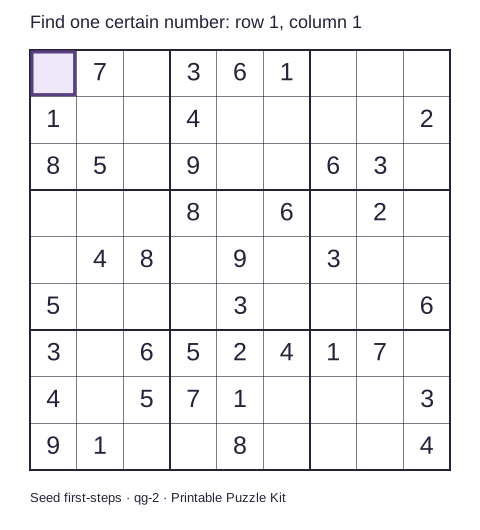
- Row 1 already contains 7, 3, 6 and 1. Its missing digits are 2, 4, 5, 8 and 9.
- Column 1 already contains 1, 8, 5, 3, 4 and 9. This removes 4, 5, 8 and 9 from that list.
- Only 2 remains. The top-left box contains no 2, so all three constraints allow it.
Check the deduction
Write 2 in row 1, column 1. This is a naked single because that cell has one candidate. It is not a guess and does not require reading the completed solution. The published grid can continue to completion using the same kind of step.
Try a blank in the bottom three rows next. Cross-check every number against both its line and box; a number missing from a row might still be excluded by its column.